Writing

Fiction

Leaf Hawk

The Lindenwood Review · Issue 14, 2024

Amidst strain in his parents' relationship, a young boy is sent alone through the woods to return a neighbor's Tupperware container. While on his errand, he encounters a story and an unexpected peril that alter his understanding of the world around him.

Cover of The Lindenwood Review

Excerpt

The cake holder perched on the table. It was easy to forget he'd come here to return that; it seemed this was a date for a social occasion rather than a practical thing like returning a borrowed item. Mrs. Bridges breathed loudly. The backs of her hands had bones protruding out of them in fanning, straight lines that seemed to lead to each of her fingers. Her skin was mottled, pink and apricot and even a little dull violet. As they sat there, a car rumbled past, and Irving didn't have time to see what kind of car it was. Mrs. Bridges looked out the window then back at him.

“Your mother requires all kinds of visitors,” she said. “Delivery men, food guys, guys collecting trash—of course we get the Ricers brothers, too, guys delivering flowers, from Bloomington, plumbers, electricians…. Rich always did all of our stuff around the house himself.”

There was a large pale blue porcelain ash tray on the table; Mrs. Bridges pulled this over. She pulled out a pack of Salem cigarettes and lit one with a small plastic lighter.

Irving drank his tea. It tasted flaky, like there were little bits unstirred together.

Mrs. Bridges stared across the room, at the screened-in porch beyond which tree branches and green leaves could be seen. “Lot of deer lately, licking the salt blocks,” she said. “Your dad would love ‘em. It’s actually good he’s not always around anymore, out in the woods. I always thought he was going to go like Richard.”

She took a puff of her cigarette. Irving watched her. Her husband had been killed in the woods by a falling tree branch. Irving gripped the wooden chair he sat on. The prospect of talking about death with an adult was terrifying. Was that really what was going to happen?

“I just knew it would,” said Mrs. Bridges. “So I’m glad he’s not out there. But I am sorry about your folks. It’s hard for people to stay happy.”

No, not death—loneliness; she was going to talk about loneliness. But then she said, “I didn’t even hear anything that morning. It wasn’t even windy.” She stopped a moment and seemed to consider. “A widow-maker, made a widow out of me. Yes, a widow-maker,” she said. “That’s what we call one of those tree branches that dangles. One of those fellas just waiting to drop. All it takes is a strong wind. Or not even that strong of a wind, just the wind at the right angle, really. And down it goes. Right on to you.” She looked at Irving. Irving didn’t know what to tell her. He didn’t have a clue. Widow-maker. It reminded him of a spider. Black widow.


Read the full story →

House-Sitting

Gargoyle · Issue 73, Fall 2021

A working-class couple house-sits for a wealthy woman, an experience that stirs reflection, comparison, and longing.

Cover of Gargoyle

Excerpt

They settled in the rich woman’s bedroom that night. It wasn’t hot but they kept the ceiling fan going, probably because they didn’t have a ceiling fan back home. Jeannie put her feet up on a footstool of pink and grey fabric. As Shepard watched TV, Jeannie played some gambling game that made loud, jangling jackpot sounds on the rich woman’s computer.

Shepard flipped through the TV menu on a commercial break and, out of the tail of his eye, caught sight of Jeannie leaving the room. She went into the master bath. Earlier, Shepard had asked what kind of woman went on a two-week trip without her computer, and Jeannie had told him she’d taken her computer, this was just one of the three that she had. Three computers?! Now Jeannie came back in wearing a long silk robe that tied at the waist.

“Well, that’s nice,” Shepard said. The red robe was glossy-looking and had some white storks embroidered on it. Storm, the German shepherd who’d been lounging next to Shepard’s chair, on the verge of sleep, whimpered and left the room, as if hating seeing her master’s robe on another woman. “Well, look at that, you made the dog leave,” Shepard said.

“How do I look?” Jeannie asked, putting one hand on her hip and the other up by her face. “Do I look good? I feel good.”

Shepard smiled. “You look amazing.” She came over and Shepard put his fingers out. “It feels like a liquid. It feels like I’m touching cold water.” He didn’t know how else to put it, how else to describe the feel of the silk robe. “Beautiful.” He looked up at his wife. “You look beautiful.”

Purchase the issue →

Bitterroot

Joyland · September 2020

A retired river guide takes her two young sons into the Montana wilderness, where grief and questions of control, masculinity, and motherhood shape their relationship to the wild and to one another.

Cover of Joyland

Excerpt

“I want to hear a story,” said Rafael, so Marta told them about the time she and their father had been hiking in this wilderness, when they had come across a black mountain lion. At first they thought it was a lion that had rolled in the ashes of the summer’s forest fires, but then, years later, they saw it again, and it was much bigger, with shoulders like boulders, and it had that same dark coat. They realized it was a true black lion. “An anomaly,” she informed them.

“Wow.” Rafael popped a grape into his mouth.

It was likely Tom would be blind by sixty. He’d been a furniture-maker all his life, was regionally known for his Quaker-style cabinetry, his elegant teak tables and arrowback dining chairs. Tom had once lived in Newfoundland, and if you looked closely you could see that he placed in each of his pieces a bit of Newfoundland’s bare, open green spaces, its stony coasts, its wind. Now barbed wire was what he worked with because it was more tactile; it demanded more from his hands than his eyes. But it was possible he wasn’t working on, making progress on his chandeliers today, but wasting time in the study, which was what he did when he was gloomy. Aimless web-surfing had become a kind of vector for his despair.

“Let’s keep hiking,” said Liam.

They made their way onto the trail and after about three miles, they came to a tree fallen across the Bitterroot. It was a log, really, a felled, branchless pine. Thirty or forty feet long, it stretched from bank to bank, the water beneath it a grade-five rapid, rock-ridden and fast. Seeing the log, Liam pushed up his sleeves. “Don’t think about it, Liam,” Marta warned him.

“It’s tempting,” he responded.

“Don’t!” said Rafael.

Marta walked a few yards and found, behind a stand of bluebunch wheatgrass, a pile of what resembled that dreadful cereal both her boys liked so much, Cocoa Puffs. She reached down and picked up one of the pellets. Mule deer scat. Cold, so it had been a while. She squeezed a single pellet and felt it crumble.

Read the full story →

Daffodils

Chicago Quarterly Review · Vol. 28, Spring 2019

A Boston-based instructor of English reckons with guilt, desire, and the damage he has inflicted on his immigrant partner.

Cover of Chicago Quarterly Review

Excerpt

The wooden flute came from Chong-Qing, Xiao’s hometown. It had eight holes in it, each separated from the other by a thin red stripe. Xiao had used the flute in a musical recital as a boy. He had very short black hair then, which came to a point at the nape his neck that his mother referred to as his “Swallow’s tail.” The flute rested, now, on a long, faux-birch table Xiao and Edgar had bought one Halloween (incidentally it was Halloween) at a Wal-Mart. Beside the flute was a flat-screen TV, also from Wal-Mart. The flute heard them speaking at night, heard Edgar saying how, on paper, he wanted active students, students who participated through much speaking, but, in actuality, he had discovered he preferred students who were quiet, who, in fact, nothing resembled how he had been as a student. The flute noticed Xiao nodding, evidently desiring just to go to sleep. Xiao had finished his reading for the night. Employed as a software engineer at a firm just north of Boston, he wanted, still, to be employed by Google, who offered breakfast and lunch on-site to its employees, and who had a splendid, glass-walled tower in Kendall Square. Accordingly, he was reading a book on programming, on algorithms that would help him crack his interview.

The flute did not know the willow tree, for the willow grew in the Public Garden, about seven miles to the south of their bedroom, but the willow tree knew that Edgar had kissed a young man by the name of Mickey whilst sitting on a bench in the Garden. The willow knew that Edgar had met Mickey on a gay hookup app called Jack’d, for, shortly before kissing—and it was a damp, gloppy, utterly unselfconscious kiss—they had spoken of the app, how, prior to this moment, they had yet to meet any interesting guys on it.

What the willow didn’t know was that, on his way home, on the train which reeked, as it always did, of marijuana, of urine, Edgar was interlocking his fingers, bouncing up and down his knees. He had an addiction, he really did. All this sex with strangers, all of this leaping into beds. What was it that he so loved about kneeling, sniffing some nineteen-year-old kid’s testicles? Why did the scent of a guy’s crotch—why was it that that he seemed to seek, and seek, and seek?

Life is ridiculous, the front door of the house did not hear Edgar say, for Edgar did not say it aloud; silent, only thinking that life is ridiculous, he closed the door, slipped his key back into his pocket, rotated the lock into place.

Purchase the issue →

The Sunken Ship

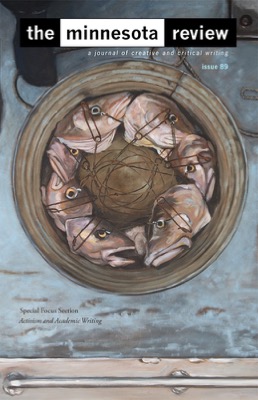
minnesota review · Issue 89, Autumn 2017

A family goes scuba diving, where the pressure of the depths mirrors the strain in their relationships.

Cover of minnesota review

Excerpt

“All the while knowing my mother does not want me to go near that ship, which is falling, I approach it,” said Ansel, “I let my flippers flap. Enclosed in my scuba mask, I breathe in. I cannot hear anything except my own breathing. Silver bubbles rise in front of my face like medallions. A perfectly blue angelfish swims past, then an orange fish striped with white. I can see the salt in this part of the ocean the way an astronaut must see the stars as she swims through those daunting white bodies of light.

“Inside the ship, there is a vast room that must have been a dining room. Grey-green stalactites hang from the ceiling. Is this how things look when they have been resting at the bottom of the ocean for a hundred years? Do all things submerged eventually accrue grey-green slime? I see a chair,” said Ansel, “I see a chandelier. Behind me, my mother enters.”

“Goose poop is what this room reminds me of,” said Lindy, “it looks as though this entire room, with its tables, its clocks, has been rained on by goose poop. My son lifts the cushion of a submerged chair. At fifteen years old, he has finished one year of high school. He has moved from his room upstairs to a room in the basement, where a faux tiger-skin rug spreads across his floor. I cook fish sticks for him often, which he loves. Why is he here, taunting me, disseminating these bits of mold as a torn pillow disseminates feathers?”

“I see the mold float in the air like spores,” said Ansel, “all the while knowing my mother is watching me. Let her watch, I say. I love my mother but I love to torment her, just as she has long tormented me. When I was much younger than I am now, she took me to a Mexican restaurant with her boyfriend, the man she broke up with my father for. We drank iceless water out of red wax cups. A mariachi band played nearby. My mother slipped one of her shoes off and slid her naked foot in between the legs of the man she was dating. I pretended not to notice. I ate my chips and salsa as she massaged his privates. I torment her, now, as she has long tormented me.”

Purchase the issue →

Chinese Dream

The Worcester Review · Vol. 28, Autumn 2017

A Fallingwater employee grapples with his partner’s desire to return to China.

Cover of The Worcester Review

Pushcart Prize Nominee

The Worcester Review

Excerpt

From the cabinet by the sink, Lester grabs a vase for the irises, then arranges the flowers in the vase to his approval. A little after seven, he serves them straight from the skillet. With a sturdy bamboo spatula, Lester scrapes the carne asada onto their respective ceramic plates.

The two of them talk about nothing, Lester rubbing the soles of his bare feet together beneath his chair as though to keep them warm. An hour ago, Wong opened the office door and told Lester to turn down the jazz on the Zenith, so Django Reinhardt wafts, barely audible, from the record player in the corner.

Not really talking, they finish off the rolls and a bottle of wine. Lester tries to ignore the fact he has finished the Riesling without Wong’s help. Through the windows in the living room, they watch a woman emerge from the building across the street wrapped in an anorak, a tiny dog on a leash at her feet. Icicles, clinging to the building’s windowsills, reflect the copper-colored glint of the streetlights. After several minutes, the woman and her dog go inside and, once more, the entrance to the building is quiet. A smattering of the woman’s footprints holds fast in the snow.

Lester reaches for the iris in its vase, plucks one of its purple petals like a feather. “Your mother called,” he says sullenly.

Wong glances at the clock on the stove. “I wonder if she’s sleeping any better.” The skin beneath his right eye twitches. A bit of cilantro is stuck in his teeth. He pries it with his tongue.

“I told her you were on the other line with a potential employer.”

Wong nods. Although his expression doesn’t change, it seems he appreciates this lie. Lester can feel it in the air around them, a rather luxurious yet dull glow.

Purchase the issue →

Memoir

The Way the World Thinks of Happiness

Willow Springs · Issue 83, 2019

Tracing a family’s history with psychiatric drugs, from a grandfather who helped develop Prozac to a mother who later became its patient.

Cover of Willow Springs

Excerpt

My grandfather refused to retire until Prozac had made it into the patent pipeline because he knew his only daughter, my mother, would need it someday. My father, who married my mother in 1987, the year Prozac was approved for marketing in the United States by the FDA, insists that, talking to my grandfather, it was easy to notice his obsession with the chronically depressed. “He was obsessed with people whose minds weren’t working the way they should be. And that obsession was born out of love for your mother,” my father said, “and empathy for what she had to go through.”

My mother’s stories about her childhood ensconce one’s mind in a brassy beige haze, what Mallarmé might’ve called an “antique flood of light”: dry-heaving in the mornings; having to finish all her scrambled eggs under her father’s watchful gaze; skipping French class with a friend to weep and smoke Salems in a bathroom stall. For as long as she can remember, my mother has been depressed. Before she had any children, she would walk to the end of her family’s driveway, sobbing for no knowable reason. She says that once or twice, wiping her eyes, she noticed her father watching her from his tractor in the adjacent field.

My mother grew up in England with her two brothers, in a Tudor house that had a back staircase for their maids and an indoor shuffle board court. My grandmother, who liked to take day trips into London to visit the British Museum, or see what the “punks” were up to in Camden Town, kept her driving gloves and linen handkerchiefs in a wooden chest in the home’s cavernous front hall. Stone walls separated three different levels of gardens, and a pink-starred rhododendron shrouded a path along the nearby hill.

In the 70s, when her family moved to a 200-acre horse farm north of Indianapolis, the FBI paid a visit to the new house. All across the country, a rash of kidnappings was occurring; men and women were stealing executives’ children and holding them for ransom. On a humid August afternoon, a trio of men in dark suits instructed my mother, her brothers and my grandmother how best to be prepared. What my mother did not tell the agents was that the enemy already was in the house.

Purchase the issue →